

Let’s start where it all began. The inclusion debate needs to be – understood within the wider context of sexism and misogyny in female sport throughout history.
Sport is a man’s world – and few things illustrate this better than the history of the Olympic Games.
Rule 2 paragraph 5 of the Olympic Charter 1996 says this…
“The IOC strongly encourages, by appropriate means, the promotion of women in sport at all levels and in all structures, with a view to the strict application of the principle of equality of men and women”.
Which basically means diddly squat if you can’t define in realistic terms what a man or a woman actually is. This statement sounds good, but ‘strongly encourages’ is typical of Olympic guidelines, which proclaim positive sentiments all too vaguely. Sports leaders will agree to such statements but soon abandon them if they prove to be inconvenient. When it comes to critical issues like equality and doping, which have a direct impact on the welfare and lives of athletes, the Olympic creed has more holes in it than a Swiss cheese from a dairy not far from the IOC headquarters in Lausanne.
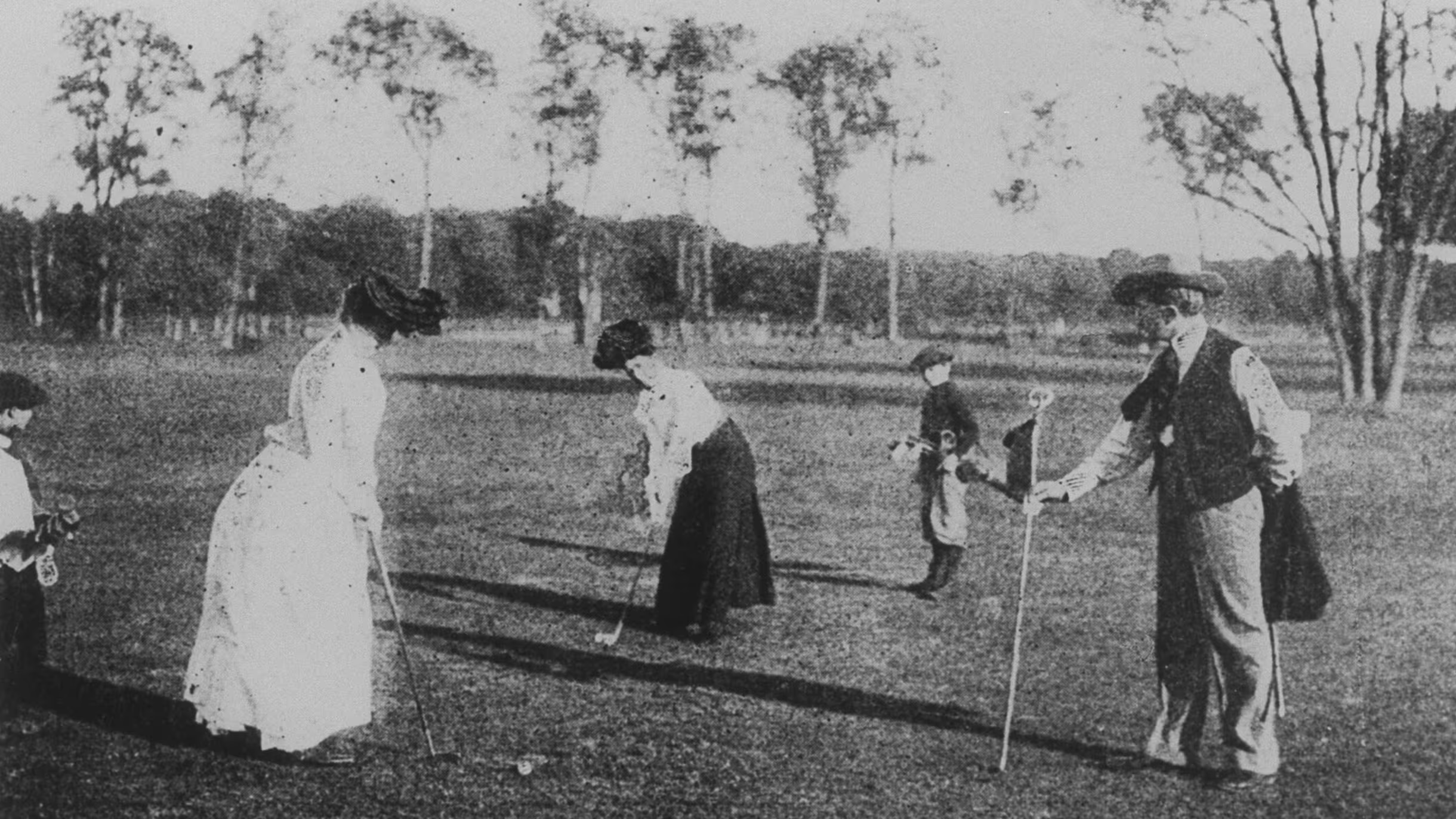
Women participating in the Olympics in 1900
Women first joined the Olympic Games as token participants in 1900, but it was 92 years before female athletes made up more than 25 per cent of all participants at the Games. In Moscow, where I won my silver medal in 1980, females where outnumbered four to one by men, and men have always had the lion’s share of opportunities and events to target. The official records of the IOC are full of known untruths, where biological males have stolen places, wins and medals from females. Or East German athletes on known doping protocols, still fill the pages of results in those historical documents.
The first biological female to cross the line in the Rio 800m on thetrack was 4th and she can never officially call herself the Olympic Champion. She was the very best human female on the track on that day, at that Olympics in a race that was supposed to give opportunity to 50% of us with a particulate biology. It’s against that backdrop that we’re told to believe that promoting gender equality within the IOC has been an important objective of the organisation since the creation of the Women and Sport Working Group in 1995. The 1970s, 80s and 90s were devastating for generations of sportswomen as a direct result of IOC decisions, while the IOC’s boast that in 1996 it took the historic step of amending the Olympic Charter to include an explicit reference to the organisation’s role in advancing women in sport. I’d argue that’s highly questionable if you can’t define fair categories, stop systematic cheating or remove males with a known physical advantage from a competition they should not be in.
The truth is that the men who have run the show for over a century are not the ones who have promoted women’s sport. Women’s sport grew thanks to female athletes and coaches, strong mothers, members of women’s rights groups and sports organisations, who had to fight long and hard every step, stride, stroke, pull, push and throw of the way to achieve equality.

Women in Sport
Pierre de Coubertin is celebrated at every opening ceremony as the founding father of the modern Olympics. The truth is that he was the father of men’s sport at the Games and the patriarch who effectively told women to stay out. The French baron said: ‘Women have but one task, that of the role of crowning the winner with garlands. In public competitions, women’s participation must be absolutely prohibited. It is indecent that spectators would be exposed to the risk of seeing the body of a woman being smashed before their eyes.’ well that brings back memories of the Paris boxing for sure. He was still trotting out sexist tropes in I919, when women dared to suggest adding other events for women at the Olympics.
Coubertin scoffed at the idea and suggested it was impractical and uninteresting. Frenchwoman Alice Milliat was not prepared to give up. She met the IOC and the International Amateur Athletic Federation, then an organisation of men for men, in 1919. She tried to persuade them to show vision and allow female participation in the Olympics. They declined. So, Alice founded the Fédération Sportive Féminine Internationale in October 1921. After organising the Women’s Olympic Games in Monte Carlo in the same year, in 1922 she set up the Women’s World Games, which were held every four years until 1934. Sadly though, I suspect that you’ve never heard of Alice?
This reminds me so much of the English FA who banned women’s football in 1921 because they believed it “quite unsuitable for females” even after women had games, watched by 1000s during the war. They feared its success would threaten the popularity and finances of the men’s games. The ban wasn’t lifted until 1971. Almost ten years after I was born. So very much in my lifetime. For fifty years women were set back by the FA much like Pierre De Coubertin managed to do.
Whether it’s big professional or Olympic sport, there is often only a small window of opportunity for women to grab attention, while men’s sport gets huge coverage every single day, for every one story on women’s sport there will be twenty for men. And that story will often fixate on what the female athlete looks like rather than the hard work or challenges behind the performance.
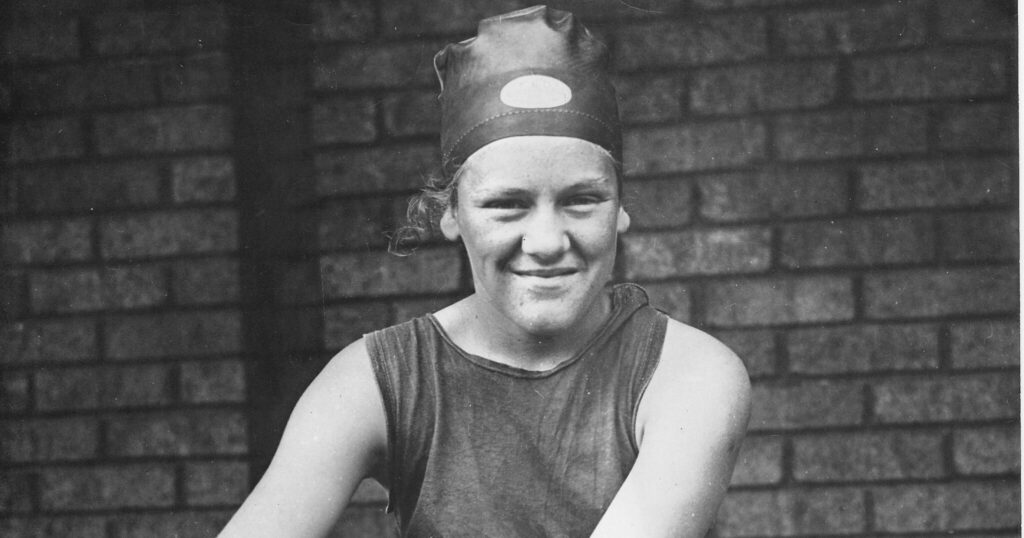
Aussie Fanny Durack a Pioneer in Olympic Women’s Swimming As The First Champion
The first women’s Olympic swim champion was Australian Fanny Durack. When she and fellow national swimming champion Wilhelmina Wylie made it known that they wanted to race at the Olympics, the New South Wales Ladies Swimming Association delivered the bad news handed down to them by the men in charge of the Australian Olympic Committee that they’d only pay for the Australian men to go to the Games, including the 21-day voyage. Eventually the women were told they could go but only if they raised enough to pay for their own tickets. So they did.
It wasn’t until Los Angeles in 1984 that women were allowed to run the marathon at the Olympics. That was 18 years after Bobbi Gibb became the first woman to complete the Boston Marathon. She didn’t do so officially, of course. The 23-year-old had to hide in a bush near the marathon start line and disguise herself in a hoodie after she was disqualified from entering the race because of her sex.
From the start of the modern Games, women have had to fight tooth and nail with every passing Olympics to get closer to true equality. It’s been a long haul. In 1900, there were just two women- only events. Men had 95. Parity has been hard fought for. Even where a sport includes both men and women, women have often been deemed incapable of covering the same distance, enduring the longer match, taking on the same number of events. We’re still not there when it comes to tennis or the decathlon.

The victorious English 400 m. women’s relay swimming team at the Stockholm Olympic Games. Postcard, 1912: Belle Moore, Jennie Fletcher, Annie Speirs, Irene Steer.
Women started swimming at the Olympic Games in 1912, but it was 2021, in Tokyo, before the women swam the same events as the men. Women swimmers did quite well. They only had to wait 16 years to compete at the Olympics. For athletes and gymnasts it was 32 years, speed skating 36 years, equestrianism 52 years. Women couldn’t be trusted with a gun for 72 years, rowers waited 76 years, cyclists 88 years, women water polo players 100 years. But the prize for the record wait is wrestling, a sport that has been part of the Olympics from the beginning in 1896: 108 years.
| Sport | Men’s Olympic Debut | Women’s Olympic Debut | Wait Time (Years) |
| Swimming | 1896 | 1912 | 16 |
| Athletics | 1896 | 1928 | 32 |
| Gymnastics | 1896 | 1928 | 32 |
| Equestrian | 1900 | 1952 | 52 |
| Shooting | 1896 | 1968 | 72 |
| Basketball | 1936 | 1976 | 40 |
| Rowing | 1900 | 1976 | 76 |
| Cycling | 1896 | 1984 | 88 |
| Football | 1900 | 1996 | 96 |
| Water Polo | 1900 | 2000 | 100 |
| Weightlifting | 1896 | 2000 | 104 |
| Wrestling | 1896 | 2004 | 108 |
| Boxing | 1904 | 2012 | 108 |
How long women had to wait to join men in Olympic Sports
It’s hard to believe, but when I raced at my second Olympics in 1980 there had still not been a single woman member of the IOC. The first one was elected in 198I: one woman and 14 men. Today, there are more women but still five times more men than women at senior executive level and twice as many men in the boardrooms overall. We can but hope with a new president and chief doctor both being female Olympians things will change?
FINA was 113 years old before it included a single woman on its top team. It took until 2000 to do that. Reform is now reshaping the sport, and, in December 2022 newly named World Aquatics took the decision to set a minimum quota for women on the board, that works out at just shy of 40 per cent. Sport is a tough place: females already have less prize money, less access, less media coverage and less profile in general. Now we’re also supposed to compete at a disadvantage, against males. The consequences include loss of places on teams, loss of chances to make finals, loss of chances to win medals and gain access to all the related opportunities that follow.
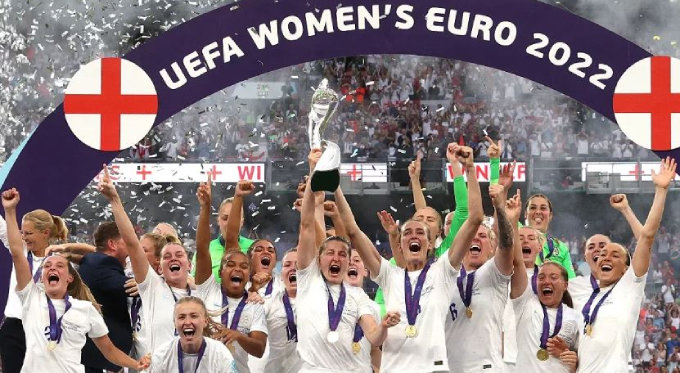
They became champions in 2022, marking the first time since 1966 that any senior England football team had won a major championship.
Despite this, the success of the Lionesses, the Roses and Emma Raducanu, and the fact that the media like to boast of having a women’s sports correspondent on their team these days, it gives the impression that we’re talking about a new golden era for women’s sport. We’re not. What is actually means is more coverage for women’s teams sports, especially the usual suspects, football and rugby, or any Brit who wins a big pro tennis title. But this isn’t the case in many other sports.
When it comes to female swimming, for example, and this applies to many sports, the new coverage has displaced much of the old. In many sports there was no need for a women’s correspondent: sport-specific correspondents like Craig Lord have been writing about women in sport for decades, and in my racing days there were three internationals a year, all televised. We had big companies like Esso and Green Shield sponsoring youth and senior swimming. Now, apart from track and field, Olympic sports are lucky if they make TV once a year, and often that’s on a red button. In 2025 the BBC, our national tax funded broadcaster decided not to show the Swimming World Championships, still one of our biggest participation sports in the UK and a lifesaving skill we need kids to have. What young girls don’t see is harder for them to emulate. And they can’t all be footballers or rugby players! Ask out on our streets to name four top UK female athletes and I’m prepared to bet most names given will actually be retired sports women.
They’d struggle to name the current top British female swimmers, even the ones who won relay gold medals in Tokyo. And that’s because we get less coverage between Olympics now than we ever have. This pretty much applies to all sports bar football, rugby and maybe a bit of track & field. Presently the BBC don’t even have rights to show next year’s home Commonwealth Games in Scotland.
The ‘Gender in Televised Sports’ report, issued by the Centre for Feminist Research at the University of Southern California, was published in 2010 and covered the 20-year period from 1989 to 2009, citing a survey of early-evening and late-night TV sports news across a range of broadcast media. We’re very similar here in the UK. By 2009, men received 96.3% of all airtime, women 1.6% and neutral topics – whatever they are 2.1%. Another study ten years later found that the picture was practically unchanged and that 80% of the televised sports news and highlights shows included zero stories on women’s sports. Not one. The research is excellent, but the findings truly depressing.
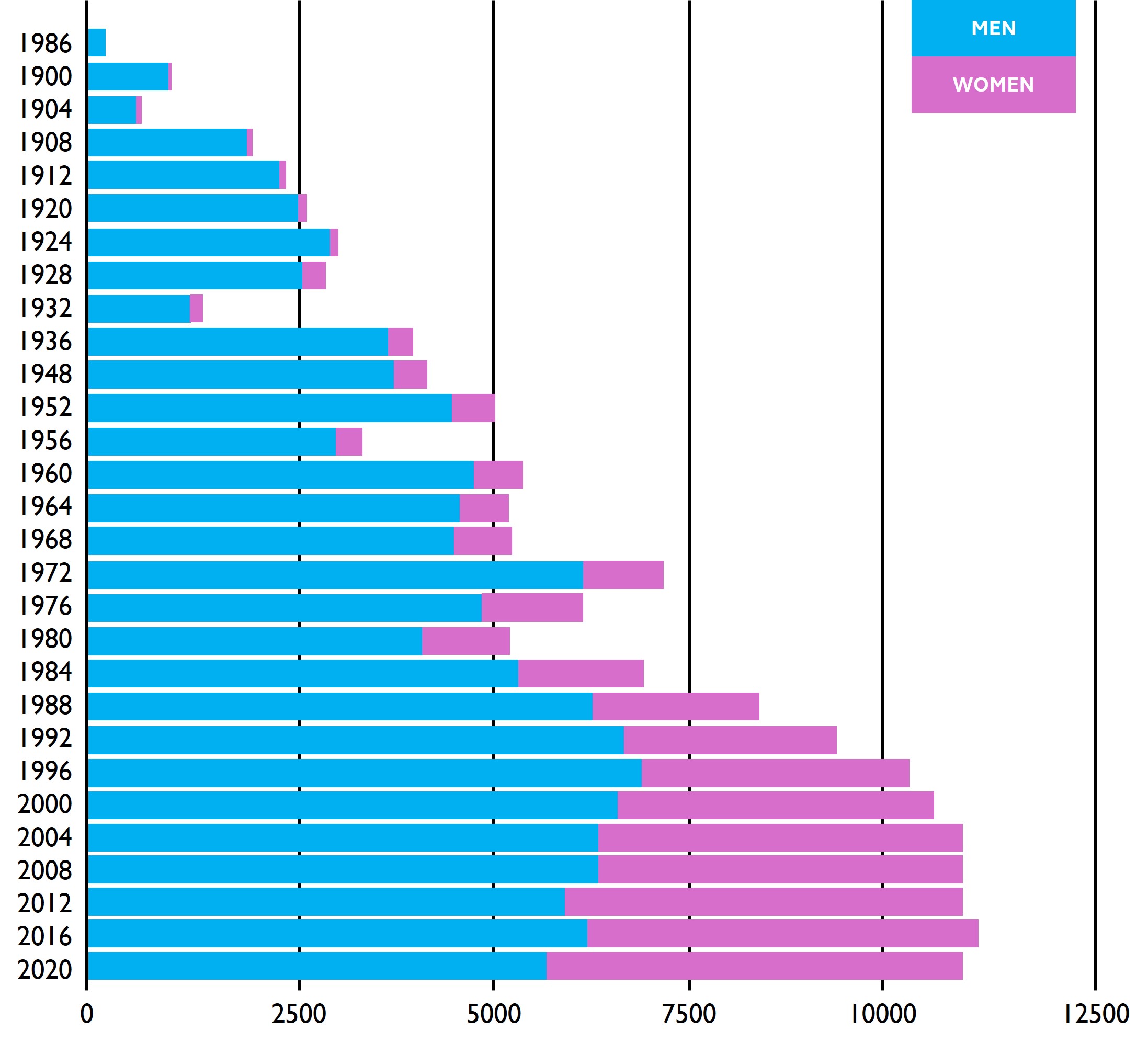
The gender gap in Olympic sport. Source: International Olympic Commitee
While women are no longer portrayed in demeaning ways most of the time, as sexual objects or as the brunt of commentators’ sarcastic comments editors pay less attention to women in general. It is not only women who are overlooked. 72% of airtime goes to men in just three sports, all traditional magnets for advertising revenue. The popularity of individual sports has to be taken into account, but there’s more than a little ‘chicken and egg’ about
If people don’t ever get an opportunity to see certain sports and women in them, it’s obvious that there won’t be an audience to grow. The rise in popularity of women’s football has surely made that point. That said, governing bodies could do so much more to help grow female participation. Whether it’s big professional or Olympic sport, there is often only a small window of opportunity for women to grab attention, while men’s sport gets huge coverage every single day. Just today I picked up the morning paper and there wasn’t one female sports story on their pages.
We once lost girls from sport at 14/15yrs old it’s now closer to 11. World athletics reported that 135 males with a male only DSD were in women’s Olympic sport from 2000 when sex screening was removed against the wishes of 82 % of female athletes polled by the IOC, until just recently when they have re-introduced it back in. The IOC must do the same, as must FIFA if we want to see our girls get their rightful sex based opportunities, with all the benefit that brings.
We must do more to protect, support and grow female participation in sport.
Sharron Davies